
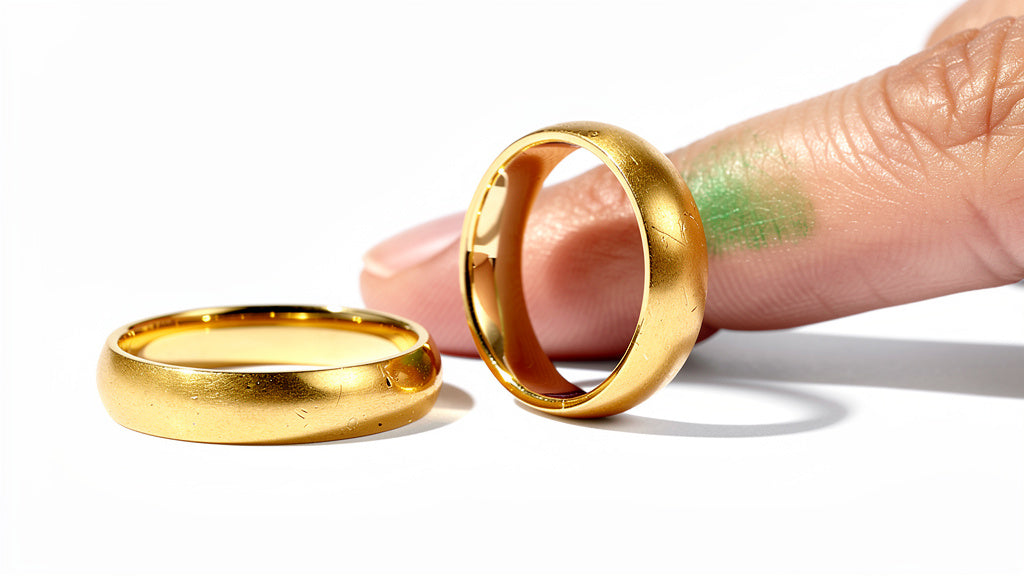
You take off a ring at the end of the day and there it is: a green or grayish ring of color on your skin. It's a little alarming, a little annoying, and it leads almost everyone to the same conclusion — "this must be fake." But the truth is more interesting than that. Green skin isn't always a sign of fake jewelry, and understanding what actually causes it tells you a lot about what you're wearing.
Here's exactly why gold (and gold-colored) jewelry turns skin green, which pieces are most likely to do it, and how to stop it.
Article Contents
The Real Cause of Green Skin
The green color is a chemical reaction — specifically, copper reacting with acids and moisture on your skin. When the copper in a piece of jewelry meets the natural oils, sweat, lotions, and slightly acidic chemistry of your skin, it forms copper salts (copper chelates). Those salts are green, and they transfer onto your skin like a faint dye.
It's the exact same reaction that turns the Statue of Liberty green — just on a much smaller, faster scale. The key takeaway: green skin is about copper, not about whether something is "real."
Does Green Skin Mean the Gold Is Fake?
Not necessarily. Here's the nuance most people miss: nearly all gold jewelry contains some copper, because pure gold is too soft to wear. Even solid 14K and 18K gold have copper in the alloy. So in theory, any gold piece can leave a faint mark under the right (acidic, humid, sweaty) conditions.

The difference is how much copper is present. A solid 14K piece has a relatively small amount of copper locked into a stable alloy. A cheap "gold-tone" or heavily plated piece can be mostly copper or brass under a thin coating — so once that coating wears, you're essentially wearing copper directly against your skin. That's when green marks become constant and obvious.
Which Metals Are to Blame
Two metals cause the vast majority of skin discoloration:
- Copper → causes green marks. Found in most alloys, but in large amounts in cheap and plated jewelry.
- Nickel and silver → can cause black or gray marks (a different reaction, more on that below).
Plated and gold-filled pieces are the biggest culprits because their core is usually brass or copper. Once the thin gold layer wears through — often within months on rings — the base metal contacts skin directly.
Why Solid 14K Gold Rarely Does It
Solid 14K gold is 58.3% pure gold, with the rest a carefully balanced alloy of copper, silver, and zinc. Because the copper is a minor, stable part of the mix — and because there's no base-metal core waiting to be exposed — solid 14K gold rarely leaves green marks under normal wear.
When a solid gold piece does leave an occasional faint mark, it's usually because of unusually acidic skin chemistry, heavy sweating, or lotions and cleaning chemicals reacting with the surface — not because the gold is failing. It also tends not to get worse over time the way a plated piece does, since there's no coating to wear away (rhodium-plated white gold is the exception, since the rhodium layer itself can wear).
Green vs. Black Marks: What's the Difference?
The color of the mark is a clue:

- Green → copper reacting with skin acids and moisture. Common with plated, copper-heavy, or low-quality pieces.
- Black → often a reaction between the metal and sulfur compounds (in some cosmetics, lotions, or even air), or fine metallic dust from friction. Can happen with silver alloys, and sometimes with makeup containing certain compounds.
Neither is dangerous, but both are signs worth paying attention to — especially if they appear quickly or worsen over time.
How to Stop Jewelry from Turning Skin Green
If you want to keep wearing a piece that marks your skin, or prevent it entirely, here's what works:
- Keep jewelry dry. Remove rings before washing hands, showering, swimming, and workouts. Moisture accelerates the reaction.
- Apply lotion and perfume first. Let them fully absorb before putting jewelry on.
- Clean pieces regularly. Removing built-up oils and residue slows the reaction.
- Keep skin's contact area dry. If your hands sweat heavily, wipe rings and fingers through the day.
- Apply a barrier (temporary fix). A coat of clear jeweler's lacquer on the inside of a plated band can delay marks — but it wears off and isn't a permanent solution.
When It's Actually a Metal Allergy
Green or black marks are cosmetic and harmless. But if you also notice itching, redness, swelling, a rash, or blistering, that's not simple discoloration — it's likely a metal allergy, most often to nickel.
If symptoms persist with any metal, a dermatologist can do a patch test to confirm what you're reacting to.
The Bottom Line
Green skin is a copper reaction, not automatic proof of fake gold — but it's far more common with plated and copper-heavy pieces than with solid gold. If a piece marks your skin constantly and worsens over time, it's almost certainly plated or low-quality. 14K gold, with its small, stable copper content and no base-metal core, is far less likely to leave a mark than plated pieces — though rhodium-plated white gold pieces are an exception, since rhodium itself can wear over time.
Shop our 14K Gold Collection, or learn how to verify what you own in our Jewelry Hallmarks Guide.






Share:
What Does 925 Mean on Jewelry? (And Why It's Not Gold)
What Do the Numbers Inside My Ring Mean? (Complete Stamp Decoder)