
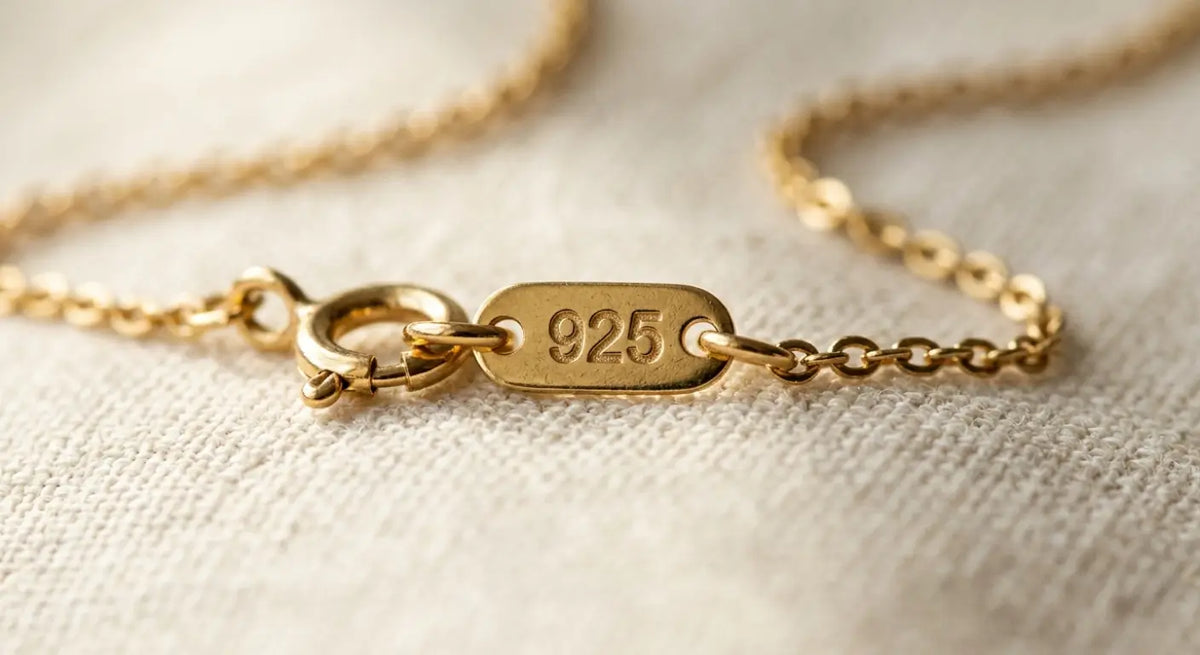
You're holding a gold-colored ring, necklace, or pair of earrings, and tucked away on the clasp or the inside of the band you spot three small numbers: 925. If the piece looks like gold, that little stamp can be confusing — because 925 doesn't mean gold at all. It means something very specific, and knowing what it tells you can save you from overpaying or misjudging what you actually own.
Here's exactly what 925 means, why it shows up on gold-looking jewelry, and how to tell the difference between a plated piece and the real thing.
Article Contents
What 925 Actually Means
The number 925 stands for sterling silver — specifically, metal that is 92.5% pure silver, with the remaining 7.5% made up of other metals (usually copper) added for strength. Pure silver is too soft to hold up to daily wear, so 92.5% is the standard sweet spot, just like 14K is the sweet spot for gold.
So when you see 925, the base metal of your piece is silver — not gold. If the piece looks gold despite the 925 stamp, that color is coming from a thin gold layer on top of the silver.

Why Is There a 925 Stamp on Gold Jewelry?
This is the part that confuses most people. If a "gold" piece is stamped 925, it's almost always gold vermeil (pronounced "ver-MAY"). Vermeil is sterling silver with a layer of gold plated over it. The 925 stamp is certifying the silver underneath — not the gold on the surface.
In the US, for a piece to legally be called vermeil, the gold layer must be at least 10K and at least 2.5 microns thick. It's a step above regular gold plating (which uses a cheap base metal like brass), but it is still a coating — not solid gold throughout.
925 vs. Solid Gold: The Real Difference
| Feature | 925 / Vermeil | Solid 14K Gold |
|---|---|---|
| Base metal | Sterling silver | Gold alloy throughout |
| Gold content | Thin surface layer only | 58.3% gold all the way through |
| Wears off? | Yes — gold layer fades over time | No — color is permanent |
| Skin reaction | Possible once layer wears | Rare |
How to Tell Vermeil from Solid Gold
The stamp itself is the fastest tell. Here's the quick decode:
- 925, 925 + a gold color → gold vermeil (silver base, gold coating)
- 14K, 14KT, or 585 (the metric fineness mark — at least 58.5% gold; 14K itself is 14 parts in 24, or 58.3%) → 14K gold
- 18K or 750 → 18K gold
- GP, GF, GE, HGE → plated or filled (base metal core)
Beyond the stamp, watch for wear at high-contact points. On a vermeil ring, the gold often wears thin on the band's underside within a year or two, revealing the silvery metal underneath. Solid gold has no layer to wear through, so its color stays consistent everywhere — including deep inside engravings.
Is 925 Jewelry "Bad"?
Not at all — sterling silver is a legitimate, beautiful precious metal, and vermeil is a real category of fine jewelry. The problem is only when 925 vermeil is sold or mistaken as solid gold. As a silver piece, 925 is great.

If you want the gold look at a lower entry price and don't mind occasional re-plating, vermeil is a reasonable option.
Other Stamps You Might See Alongside 925
925 rarely travels alone. You might also spot:
- A maker's mark — the logo or initials of the manufacturer
- "STG" or "STER" — abbreviations for sterling, confirming the 925
- A country stamp — like "Italy" or "Thailand," indicating where it was made
- A vermeil note — occasionally pieces are stamped with both 925 and a karat to indicate the gold layer's purity
What to Look For If You Want Real Gold
If your goal is real gold, look for these signals:
- A clear 14K, 585, 18K, or 750 stamp — never 925 on a piece sold as gold
- Hallmark photos in the product listing
- A seller who clearly distinguishes solid gold from vermeil and plated pieces
Once you can read the stamp, the next question is which purity to buy. We explain the trade-offs in why 14K gold is the best choice for everyday jewelry.
The Bottom Line
A 925 stamp means sterling silver — and on a gold-colored piece, it means gold vermeil: silver with a thin gold coating. It's a real precious metal and a legitimate type of jewelry, but it's not solid gold, and the gold layer will wear away over time. When you want gold that stays gold, look for 14K or 585, not 925.
Want to skip the guesswork entirely? Shop our 14K Gold Collection, or learn to read every stamp in our Jewelry Hallmarks Guide.





Share:
Anniversary Gifts by Year: Modern Jewelry Ideas for Every Milestone
Why Does Gold Turn Your Skin Green? (And How to Stop It)