
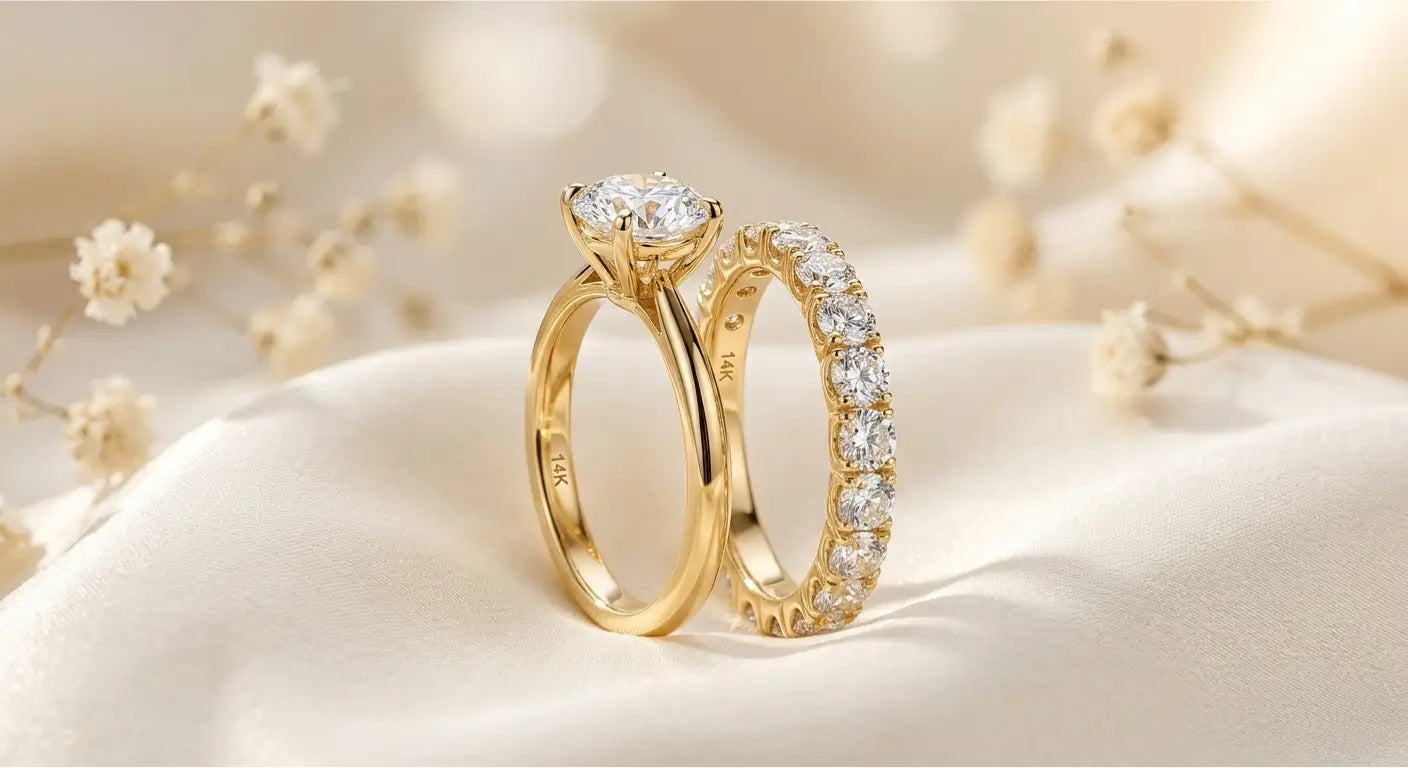
You said yes to the engagement ring. Now comes the second ring decision: the wedding band that sits next to it for the next sixty years. The wedding band is the more permanent of the two — it goes on at the altar, and most women never take it off. So choosing it deserves real thought.
Here's how to think about every major wedding band style, how each one pairs with different engagement ring designs, and the practical considerations most brides don't hear about until after they've already bought.
Article Contents
The Six Main Wedding Band Styles
1. Plain Gold Band
The classic. A smooth, unadorned band in 14K gold. Quiet, timeless, and effortless to pair with any engagement ring.
- Pairs best with: Any engagement ring — especially halo, three-stone, or pavé settings where the e-ring is already detailed.
- Best width: 2–3mm to sit comfortably without competing.
- Personality: Timeless, minimal, lets the engagement ring lead.
2. Pavé Band
A band set with small diamonds (or stones) along part or all of its surface — "pavé" means "paved" with stones. Adds continuous sparkle without bulk.
- Pairs best with: A solitaire e-ring (adds sparkle the e-ring doesn't have), or a pavé e-ring (extends the look).
- Width: Usually 1.5–2.5mm.
- Personality: Romantic, sparkly, modern-classic.
3. Eternity Band
Diamonds (or gemstones) set continuously around the entire band. The most luxurious wedding band style — and a popular choice as an anniversary upgrade as well.

- Pairs best with: Solitaires, three-stone rings, simpler e-ring designs.
- Note: True full eternity bands cannot be resized. If you anticipate finger size changes (pregnancy, weight changes, age), consider a half-eternity instead.
- Personality: Bold, statement, "forever" symbolism is built in.
4. Half-Eternity Band
Stones set on the top half (the visible half when worn) and a plain band underneath. Almost identical visual impact to a full eternity band, but resizable and easier to wear daily.
- Pairs best with: Any engagement ring style.
- Pro tip: The most practical eternity-style choice — most jewelers recommend it over full eternity for daily wearers.
5. Curved or Contoured Band
A band shaped to nestle flush against an engagement ring with a unique silhouette. Curved bands solve a real problem: not every e-ring sits flat against a straight band.
- Pairs best with: Halo rings, pear-cut e-rings, marquise stones, or any e-ring with a curved gallery.
- Personality: Custom-feeling, fitted, intentional.
6. Stacked / Multi-Band Look
Two or more thin bands worn together — often plain + pavé, or three thin bands of mixed metals. A modern alternative to a single wedding band.
- Pairs best with: Minimalist e-rings, solo or no e-ring (for those who choose to skip the engagement ring entirely).
- Future-proof: You can add bands on each anniversary, building the stack over time.
Eternity Ring vs. Wedding Band: What's the Difference?
The two terms get used as if they were rivals, but they answer different questions. "Wedding band" describes the ring's job — the one exchanged at the ceremony and worn daily afterwards. "Eternity ring" describes a style: a continuous line of stones, cubic zirconia in our case, running around the band. An eternity ring can be the wedding band, and just as often it arrives later, given at a first anniversary or after the birth of a child.
That is why the choice is rarely either-or. Plenty of women wear a plain band from the ceremony and add an eternity or half-eternity style years later, so the stack grows with the marriage instead of being settled in one afternoon.
Finish changes a band more than most brides expect. A high-polish band has a mirror surface and reads traditional. A matte or brushed finish is quieter and more contemporary, and it hides the fine scratches any daily ring collects. Ask about a comfort fit as well — a domed interior makes a band far easier to wear around the clock.
Flush or gapped? If the engagement ring sits low, a curved band will hug the center setting with no daylight between them. If it sits high, a straight band that leaves a deliberate small gap looks intentional rather than mismatched, and it saves you the cost of a contoured band.
Pairing Guide by Engagement Ring Style
| Engagement Ring | Best Band Pairing |
|---|---|
| Round Solitaire | Plain, pavé, or half-eternity |
| Oval Solitaire | Plain or pavé, curved if low-set |
| Halo | Plain band or curved contour |
| Three-Stone | Plain band, thin pavé |
| Pavé E-Ring | Matching pavé band |
| Vintage / Cathedral | Curved or detailed band |
| Pear or Marquise | Curved contour band |
Practical Considerations Most Brides Overlook
Finger Size Changes Over Time
Fingers swell and shrink throughout life — pregnancy, weight changes, age, even time of year. A full eternity band can't be resized; a half-eternity or plain band can. If you're unsure, choose resizable.
Lifestyle Match
If you work with your hands daily (medical, kitchen, gym, gardening), high-set stones in pavé or eternity bands snag easier. A flush-set band or bezel-set diamonds wear more comfortably long-term.

Metal Color Matching
Your wedding band should match your engagement ring metal exactly. A 14K yellow gold e-ring deserves a 14K yellow gold band. Mixing metals on the same finger usually looks unintentional.
Width and Stack Comfort
A 2mm band sits comfortably even alongside a wider e-ring. A 4mm band feels heavier and may shift the stack's balance. Try them on stacked together before committing.
When to Buy the Wedding Band
Most brides buy the band 3–6 months before the wedding. Earlier if:
- You're considering a custom or curved band (longer production time)
- You want a band that arrives the same time as the engagement ring
- You're ordering a full eternity (sizing must be exact)
One Band or Multiple?
Modern brides increasingly buy two or three wedding-stack pieces — the actual wedding band plus a future anniversary band ready to add later. Stacked bridal sets are one of the fastest-growing trends in 2026, and they're a way to plan ahead for future milestone moments.
Frequently Asked Questions
What is the difference between a wedding band and an eternity ring?
A wedding band is defined by its role: it is the ring exchanged at the ceremony. An eternity ring is defined by its design, a continuous line of stones around the band. An eternity ring can serve as the wedding band, but it is just as often added later to mark an anniversary or the birth of a child.
Can an eternity band be resized?
A full eternity band cannot, because the stones run the whole way around and there is no plain metal to cut into. A half-eternity band keeps the lower half plain, so it can be resized and is the more practical choice if your finger size is likely to change.
Should the wedding band sit flush against the engagement ring?
Only if the engagement ring sits low enough for it to. A curved or contoured band closes the gap under a low setting. With a higher setting, a straight band that leaves a small, even gap looks deliberate, and it costs less than a custom contour.
The Bottom Line
The most important question isn't "which band is most beautiful?" — it's "which band will I want to wear every single day for the rest of my life?" The answer for most women is something quiet enough to live in and special enough to matter. That usually means a thin plain band or half-eternity in 14K solid gold.
Browse the full bridal collection in our 14K Gold Ring Collection, or read our guide to yellow, white, and rose gold if you are still deciding on metal color.







Share:
How to Store Gold Jewelry the Right Way (Prevent Scratches & Tangles)
Why 14K Gold Is the Best Choice for Everyday Fine Jewelry