
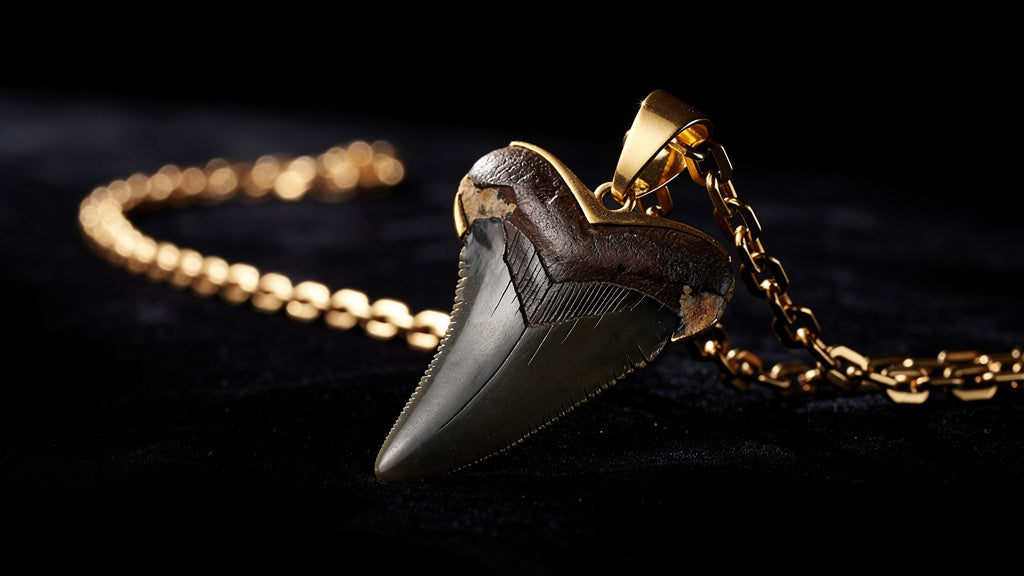
A megalodon tooth necklace looks bold, but how do you know the tooth is real? And what should a good one cost? Here is how a jeweler sizes up a fossil pendant, from the tooth to the chain.
The short answer: judge the tooth, the setting and the chain as three separate things. A great fossil on a weak cord will not last. A fine chain with a chipped, repaired tooth is no bargain either.
- Real teeth show fine serrated edges, natural wear and a dark, glossy color. Perfect, uniform teeth are often casts.
- Price depends on size, condition and color. Ask whether the tooth has been repaired or restored.
- Gold hardware and a sturdy chain protect a heavy pendant and keep it from snagging.
What a megalodon tooth necklace is
The megalodon was a huge prehistoric shark. It died out millions of years ago. Its teeth stayed behind in sediment and turned into fossils.
A megalodon tooth necklace hangs one of those fossils as a pendant. The tooth is triangular, with a wide base and a pointed tip. Most are dark gray, brown or black, though some show blue or tan tones.
People wear them for the look and the story. The tooth is a natural object, so no two are the same. That is the whole appeal.
You will also see "real shark tooth necklace" and "great white shark tooth necklace" in shops. Those are different teeth. Great white teeth are smaller and still sharp-edged. Megalodon teeth are much larger and heavier.
How to tell a real tooth from a copy
Resin casts and carved bone are common. A few checks help you spot them before you buy.
Look at the edges
A real tooth often has tiny serrations along both sides. They can be worn down on older teeth. Under a loupe, the edge should look natural and a little uneven.
Check the surface
Fossil enamel is smooth and glossy, with fine lines and small marks. A cast often looks too clean. It may show bubbles, seams or a painted shine.
Feel the weight
A real fossil feels dense and cool in the hand. A resin copy feels light and warms up fast.
Ask about repairs
Some sellers glue pieces together or fill gaps. That is not always bad, but it should be stated. A repaired tooth is worth less than a whole one.

What a real tooth costs
People often ask what a real megalodon tooth costs. There is no single price. Size is the biggest factor, followed by condition and color.
Small teeth with some wear cost the least. Large, whole teeth with sharp serrations and rich color cost far more. Bright blue or deep black enamel is prized.
A pendant also carries the cost of the setting. A tooth in a wire wrap costs less than one framed in solid gold.
| Factor | Higher value | Lower value |
|---|---|---|
| Size | Large, wide base | Small or narrow |
| Condition | Whole, no repair | Glued or filled |
| Edges | Sharp serrations | Worn smooth |
| Color | Deep black or blue | Dull tan or chalky |
| Setting | Solid gold | Thin wire or cord |
Settings, chains and cords
A tooth pendant is heavy for its size. The bail, which is the loop on top, takes all the strain. A weak bail is the most common reason pendants fall off.
Gold is a smart choice here. It resists wear and keeps its shape. Solid 14K gold is 58.5% pure gold, which makes it stronger than softer, higher-karat metal.
Chains matter just as much. A thin chain can kink under a heavy tooth. A sturdier link, such as a rope or curb, holds the weight better. Browse the Gold Chains collection to compare link styles.
Black cord is another classic look. It suits a casual style, but cord frays and needs replacing over time. A chain lasts longer.
Many buyers pair a fossil pendant with a plain gold chain and wear the tooth alone. Others layer it with a finer chain above. Our necklace length chart shows where each length falls on the body.

Styles and who they suit
Fossil pendants come in a few main looks. Each one gives a different feel.
A wire-wrapped tooth is rugged and handmade in spirit. It suits a relaxed, outdoorsy wardrobe. The wrap should be tight and even, with no loose ends that can snag.
A tooth framed in a metal cap is cleaner and more polished. The cap hides the base of the tooth, so check that the fit is snug. A gap lets dirt in and can let the tooth shift.
A gold-plated copy gives the look at a low price, but it is not a fossil. Know which one you are buying. Plating also wears thin over time, while solid gold does not.
Fossil teeth are popular gifts for people who love the ocean, fossils or history. They also suit men who want one bold piece rather than a stack of chains. A single pendant on a medium-length chain looks simple and strong.
Size the tooth to the wearer. A very large tooth can feel heavy by the end of the day. A mid-size tooth is easier to wear for hours and still turns heads.
A quick buying checklist
Before you pay, run through these points:
- Ask if the tooth is whole, repaired or restored.
- Ask where the tooth was found and how it was cleaned.
- Check that the bail is firm and sits at the center.
- Look at the chain link and clasp, not just the tooth.
- Get clear photos of both sides of the tooth.
A seller who can answer these points plainly is a good sign. Vague replies are a warning.
How to wear and care for it
A large tooth is a statement piece. Wear it over a plain tee, a knit or an open collar. A shorter chain keeps it from swinging into things.
Fossil enamel is hard but can chip. Take the necklace off before sports, sleep or heavy work. Store it flat or hanging, away from other jewelry.
For cleaning, wipe the tooth with a soft, dry cloth. Skip harsh cleaners, since they can dull the finish. Your gold parts need their own care. Our guide on cleaning 14K gold at home covers the chain and clasp.
Keep the pendant out of water when you can. Salt and chlorine are tough on fossils and on cord. See our note on wearing gold jewelry in water for the metal side.
Frequently Asked Questions
What is a shark necklace?
A shark necklace hangs a shark tooth or a shark-shaped charm on a chain or cord. Fossil tooth versions use real teeth that are millions of years old. Others use modern teeth or cast copies.
What does a real megalodon tooth cost?
It varies widely. Small, worn teeth cost the least. Large, whole teeth with sharp edges and rich color cost much more. A gold setting adds to the price of the finished necklace.
Has a real megalodon ever been found?
Not as a whole animal. Megalodon had a skeleton of cartilage, which rarely fossilizes. Scientists know it from teeth and a few vertebrae.
How can I tell if a megalodon tooth is real?
Look for natural serrations, glossy enamel with fine lines and a dense, cool feel. Be wary of teeth that look flawless or feel light. Ask the seller about any repairs.
What chain is best for a heavy tooth pendant?
Pick a sturdy link such as a rope or curb chain. Thin chains can kink under the weight. Make sure the clasp and bail are strong too.
The Bottom Line
A good megalodon tooth necklace starts with an honest tooth and ends with hardware that can carry it. Check the edges, ask about repairs and choose a chain built for the weight.
Ready to pick a chain for your pendant? Start with our 14K Gold Necklaces collection.



Share:
Engagement Finger: Which Finger the Ring Goes On