

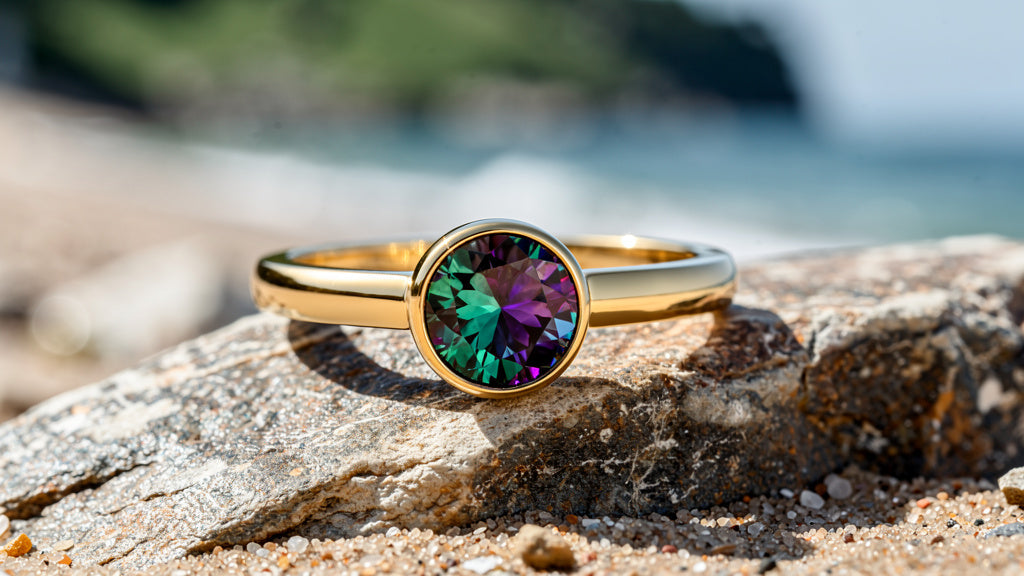
You spot a stone that looks blue-green in one photo and purple-red in the next. That is not a filter. It is alexandrite, one of the rarest color-change gems on Earth.
This guide covers what the alexandrite stone actually is, why it shifts color, what it costs, and how to shop for the look without the natural gem's price tag.
- Alexandrite is a chrysoberyl gem that shifts from blue-green in daylight to purplish-red under warm light.
- It is June's birthstone and the gem for a 55th wedding anniversary, but fine natural stones are extremely rare and costly.
- Most alexandrite-look jewelry today uses a simulated color-change stone set in solid gold, which gives the same effect at an everyday price.
What Is Alexandrite Stone?
The alexandrite stone is a variety of chrysoberyl, a mineral that also produces cat's-eye gems. What sets it apart is a rare mix of trace elements that bend light in two different ways.
Gem cutters often call it "emerald by day, ruby by night." That nickname captures the color shift better than any technical term.
Fine natural alexandrite was first found in Russia's Ural Mountains in the 1830s. Miners named it after the future Tsar Alexander II, and it quickly became a favorite of Russian nobility.
Green and red were the colors of the Imperial Russian Guard, so a stone that showed both felt like a national symbol. That story is part of why alexandrite still carries a sense of prestige today.
Why Does Alexandrite Change Color?
The alexandrite stone absorbs light unevenly across the color spectrum. In daylight, which is rich in blue and green wavelengths, the stone reads as blue-green to teal.
Switch to a warm incandescent bulb or candlelight, and the mix of wavelengths flips. The same stone now reads purplish-red to raspberry.
This is called pleochroism combined with a color-change effect, and very few gems show it this strongly. Sapphire, garnet, and some spinel show mild shifts, but alexandrite's swing is the most dramatic of any common gem.
The strength of the shift depends on the exact chemistry of each stone. A gem with a clean, strong flip from green to red is rarer, and more prized, than one with a muddy in-between color.

Where Does Alexandrite Come From?
The original Russian deposits that made alexandrite famous are largely mined out today. Most of what collectors call "Russian alexandrite" on the market now is antique jewelry, not new production.
Brazil became a major source in the 1980s, producing stones with a strong color shift but often smaller than the historic Russian material. Sri Lanka and parts of East Africa, including Tanzania, also produce small amounts of fine-quality alexandrite.
Because every modern source is limited, large, clean, richly color-changing stones stay rare no matter where they come from. That scarcity is the single biggest driver of natural alexandrite stone price.
Alexandrite as a Birthstone and Anniversary Gem
Alexandrite is one of two official birthstones for June, alongside pearl. If your birthday falls in June, it is a personal and easy gift idea.
It is also the traditional gem for a 55th wedding anniversary. Few couples reach that milestone, which makes an alexandrite stone birthstone piece feel genuinely special when they do.
Some zodiac traditions link the stone to Gemini. That pairing is folklore, not a rule, so anyone drawn to the color shift can wear it.
How Much Does Alexandrite Cost?
Price depends almost entirely on whether the alexandrite stone is natural or simulated. The gap between the two is enormous.
Natural alexandrite stone price climbs fast with size because large, strongly color-changing crystals are so scarce. A one-carat natural stone with a clean shift can cost more than a one-carat diamond.
Natural vs. Simulated Alexandrite
Natural alexandrite stone supply is tiny. Most of the historic Russian mines are exhausted, and newer sources in Brazil and Sri Lanka still produce very little fine material.
That scarcity is why almost every affordable "alexandrite" ring or pendant you see today uses a simulated stone. Golden Planet Jewelry sets ours in solid 14K gold, so the metal is real even when the color-changing stone is simulated.
| Trait | Detail |
|---|---|
| Mineral family | Chrysoberyl |
| Color in daylight | Blue-green to teal |
| Color in warm light | Purplish-red to raspberry |
| Hardness (Mohs scale) | 8.5, tough enough for daily wear |
| Birthstone month | June |
| Anniversary gem | 55th wedding anniversary |
| Rarity | Among the rarest gems in fine natural form |
A jeweler can tell the two apart with a loupe and a light test, but to the eye across a room, a well-cut simulated stone shows the same red-to-green shift. Most shoppers buy it for that look, not as an investment piece.
Cut also affects how well a stone shows the color change. Oval and cushion cuts tend to show the shift more evenly across the whole stone than very shallow cuts, so it is worth asking about the cut before you buy.

How to Wear and Care for Alexandrite Jewelry
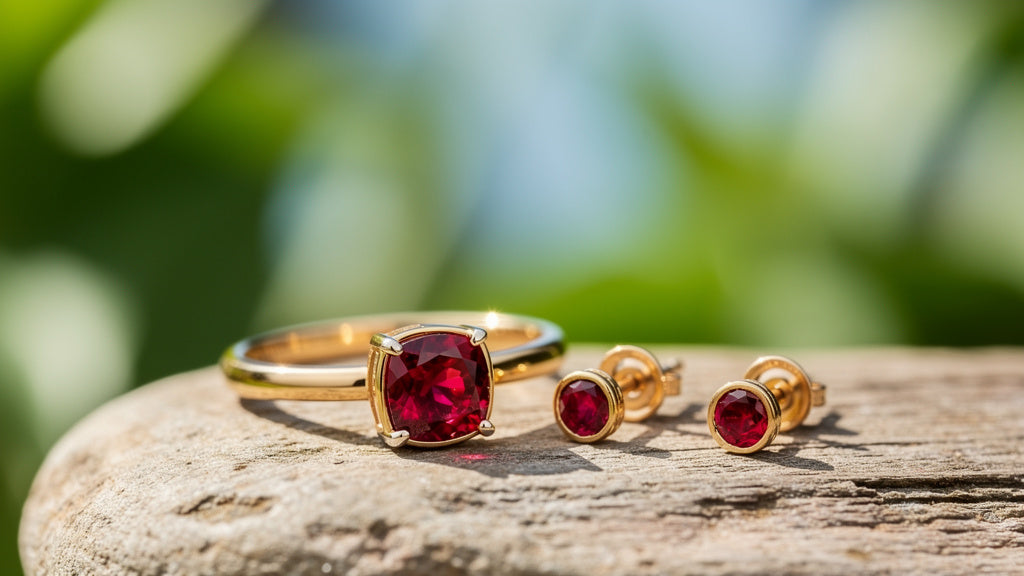
An alexandrite stone ring shows the color change best, since your hand moves through different light all day. Pendants and stud earrings work well too, especially near a window or under warm indoor lighting.
Pair it with yellow or rose gold for a warmer overall look, or white gold if you want the color shift to read as the main event. Our guide to white, yellow, and rose gold breaks down which tone suits your skin and style.
Clean it the way you would any fine gold piece: warm water, a drop of mild soap, and a soft brush around the setting. Dry it fully before you put it away, and store it flat so the stone does not knock against other jewelry.
A ring gets the most daily contact, so check the prongs every few months to make sure the stone still sits tight. Pendants and earrings see less wear and tear, which makes them a lower-maintenance way to try the color-change look.
Frequently Asked Questions
Is alexandrite an expensive stone?
Natural alexandrite can be very expensive, often more per carat than a diamond, because large color-changing crystals are so rare. Simulated color-change stones give the same look for a fraction of the cost.
Who cannot wear alexandrite?
There is no rule against wearing it. Some zodiac traditions pair it with Gemini, but that is folklore, and the stone is hard enough (8.5 on the Mohs scale) for daily wear by anyone.
Whose birthstone is alexandrite?
Alexandrite is one of two official birthstones for June, along with pearl. It is also the traditional 55th wedding anniversary gem.
Why is alexandrite so special?
It shows one of the strongest color changes of any gem, shifting from blue-green in daylight to purplish-red in warm light. That effect, plus its rarity in fine natural form, makes it a favorite among collectors.
How can you tell if alexandrite is real?
A jeweler checks it under different light sources and with a loupe, since lab tools can confirm the mineral. At home, the clearest clue is price: a large, richly color-changing natural stone is never cheap.
The Bottom Line
The alexandrite stone earns its reputation honestly. Few gems shift color this dramatically, and fewer still are this rare in fine natural form.
If you love the look but not the price of a natural stone, a simulated color-change piece set in solid 14K gold gives you the same red-to-green effect every day. Browse our 14K Gold Rings collection to find a setting that shows it off.



Share:
What Is 14K Gold? Purity, Price, and Durability Explained
Earring Findings: Types, Materials, and How to Choose