
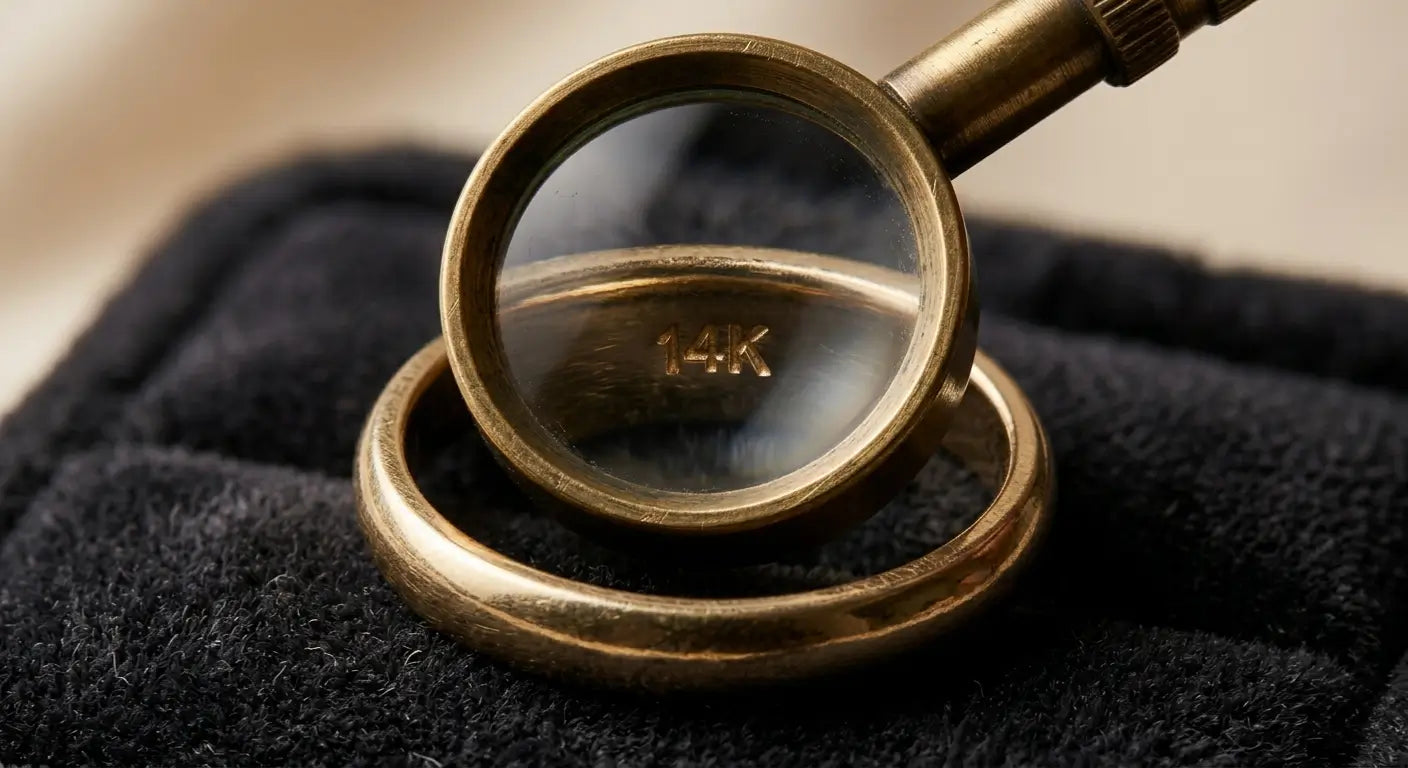
You inherited a ring from your grandmother. You bought a chain at a flea market. You ordered a “14K gold” necklace from a site you don’t fully trust. The question is the same every time: is this actually gold?
The good news is you don’t need a jeweler’s license to find out. There are eight tests you can do at home, ranging from a 10-second visual check to a more advanced acid test. Use a combination, not just one — any single test can be fooled, but two or three matching results give you a reliable answer.
Test 1 — The Hallmark Stamp (Start Here)
Real fine gold jewelry is almost always stamped. Look on the inside of rings, on clasps, or on the back of pendants for a tiny mark:
- 14K, 14KT, or 585 = 14-karat gold
- 18K, 18KT, or 750 = 18-karat gold (75% pure)
- 24K or 999 = pure gold
- GF, GP, HGP, GE, or RGP = not solid gold (gold filled, gold plated, heavy gold plated, gold electroplate, rolled gold plate)
No stamp at all? That alone isn’t proof of fake — very old pieces sometimes weren’t marked — but it’s a yellow flag worth investigating with the other tests below. If you’re trying to tell if unmarked gold is real or fake, don’t stop at the missing stamp — run at least two of the physical tests below before you decide.
Test 2 — The Magnet Test
Gold is not magnetic. Hold a strong magnet (a neodymium magnet, not a fridge magnet) close to the piece. If it pulls toward the magnet, it contains a magnetic metal core — meaning it’s either plated or fake.
Caveat: The reverse isn’t guaranteed. Some fake gold uses non-magnetic base metals like copper or brass. A “no magnet attraction” result just rules out the cheapest fakes.

Test 3 — The Water Density Test
Gold is dense. Drop the piece into a glass of water. Real gold sinks immediately and decisively. Plated jewelry over lighter base metals can float, drift, or sink slowly.
This test won’t tell you the karat, but it’s a quick disqualifier for hollow or very lightweight fakes. Want a sharper read? Stir in a tablespoon of salt first. Salt water is denser, so a borderline piece that barely sinks in plain water will float or hover in salt water if it’s hollow or lightweight — a simple upgrade if you’re identifying gold at home with water and want more confidence in the result.
Test 4 — The Skin Test
Hold a piece against the inside of your wrist or rub it lightly on your forehead and check after 30 seconds. Fake gold or low-quality alloys often leave a green, black, or gray mark — that’s the base metal oxidizing.
Note: Even genuine 14K can leave faint marks on highly acidic skin, but never the dramatic green you’d see from a plated piece breaking down.
Test 5 — The Vinegar Test
Place a drop or two of white vinegar on an inconspicuous spot. Real gold doesn’t react. Plated or fake gold will change color — typically darkening or developing a stain — because the acid reacts with the underlying base metal.
Rinse immediately after testing and pat dry. Some people run the same idea with a dab of white toothpaste instead of vinegar — the same blackening shows up on fakes — but vinegar’s clearer, faster reaction makes it the more reliable of the two.
Test 6 — The Ceramic Scratch Test
Find an unglazed ceramic surface (the bottom of a coffee mug works). Lightly drag the piece across it.

- Real gold leaves a gold-colored streak.
- Fake gold leaves a black or gray streak.
Use this test carefully — it can leave a tiny mark on the piece. Test on a spot that won’t show.
Test 7 — The Acid Test (Most Definitive)
Jewelers use gold testing acid kits, available online for under $30. Each kit comes with separate acids calibrated to 10K, 14K, 18K, and 22K. You make a tiny scratch on a testing stone, place a drop of acid on it, and observe the reaction:
- The streak dissolves → metal is below that karat.
- The streak remains → metal is at or above that karat.
This is the closest you can get to professional accuracy at home. Just be careful — these are real acids.
Test 8 — Weight, Color, and the Flame Test
Three more clues, and none of them need chemicals. First, weight: gold is one of the densest common metals, so a real 14K piece feels noticeably heavier in your palm than a same-size piece in brass, copper, or gold-plated base metal. Pick up a similar-looking item and compare — real gold rarely feels light.
Second, color: genuine gold has a warm, slightly muted yellow. If a piece looks too bright, too pale, or almost brassy in daylight, that shift in tone is a warning sign, not just a style choice. A clean piece makes this comparison easier — see our guide on how to clean 14K gold jewelry at home before you judge the tone.
Third, the flame test: heat a small, hidden spot with a lighter for five to ten seconds, then let it cool. Real gold keeps its color and shine. Plated or fake metal often blackens, blisters, or gives off a sharp metallic smell as the base metal reacts to the heat. Skip this test on pieces with stones or glued parts, since heat can damage both.
Warning Signs of Fake or Plated Gold
- Suspiciously low price — 14K gold has a real material cost
- “925” or “sterling” stamp on a “gold” piece (that’s silver with gold plating)
- Visible chipping or peeling at high-wear points (band edges, clasp tips)
- Discoloration on the skin underneath after a few wears
- A noticeable color shift between the outside and a deep scratch
- Magnetic attraction
Already seeing a color change where the plating has worn through? Our guide on why gold jewelry fades walks through what that means and what to do next.
Plated, Filled, Vermeil — They’re Not Fake, But They’re Not Solid Gold
Important distinction: gold plated, gold filled, and vermeil are all real categories of legitimate jewelry — but they’re not solid gold. They have a thin layer of gold over a base metal core. Over time, that layer wears off, exposing the metal underneath. Solid 14K gold, by contrast, is gold all the way through.
When to Take It to a Professional
If the home tests give mixed results, or if the piece is sentimental and you don’t want to risk a scratch test, take it to a certified appraiser or a reputable local jeweler. Most will do a quick verification for free or a small fee using XRF analysis — a non-destructive scan that tells you exactly which metals are in the piece and at what percentages.
Frequently Asked Questions
Can gold be fake if it says 14K?
Is gold real just because it carries a 14K stamp? Not always. Stamps can be forged, mismatched to the wrong piece, or added to a plated item by a dishonest seller. Treat the stamp as your starting clue, not your final answer, and confirm it with at least one physical test like the magnet or vinegar test above.
Can you tell if gold is real by biting it?
Not reliably, so it isn’t worth trying. Gold is soft enough that a bite can mark very high-karat pieces, but other metals can show the same mark, and a bite tells you nothing about karat or purity. It can also crack a tooth or damage the jewelry. Stick to the hallmark, magnet, water, and vinegar tests instead.
Why This Matters When Buying Online
Marketplaces are flooded with “14K gold” jewelry that turns out to be plated. Look for sellers who clearly state 14K gold, show hallmark photos, and provide return policies.
Once you’ve confirmed a piece is solid 14K, browse our Best Sellers collection to see what genuine, made-to-order gold jewelry looks like from a brand that stands behind every stamp.





Share:
14K Gold Chain Types Explained: Cuban, Rope, Figaro, Box & More
The Ultimate Gold Jewelry Gift Guide for Her (By Occasion & Budget)