
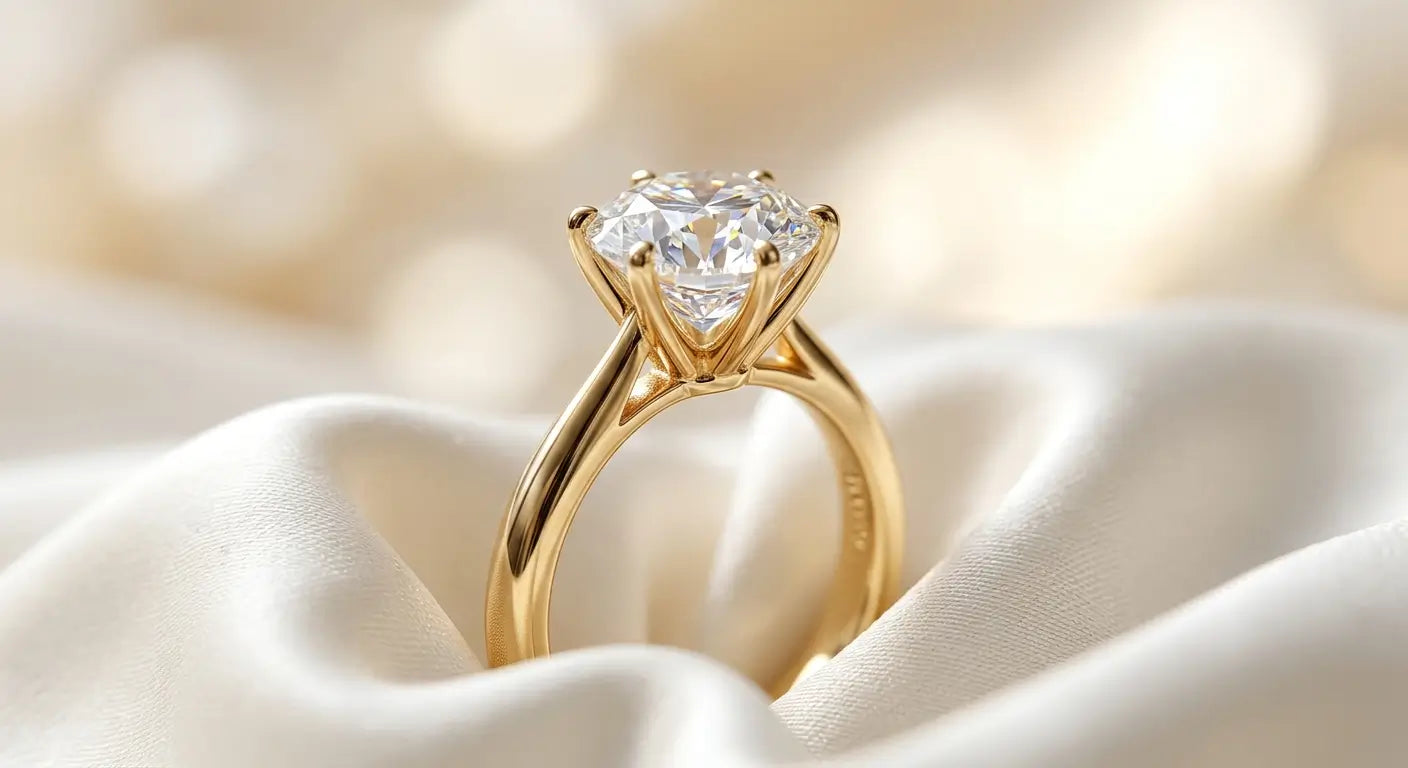
Buying an engagement ring is one of the most personal — and most expensive — pieces of jewelry most people will ever buy. It’s also one of the most confusing. Carat, color, clarity, cut, setting, metal, stone type, budget — and somewhere underneath all of that, the question that actually matters: will she love it?
This guide walks through every decision in plain English. No jargon for jargon’s sake. By the end, you’ll know exactly how to choose an engagement ring that fits her style, your budget, and the life you’re building together.
Step 1 — Set a Budget You’re Comfortable With
The old “three months’ salary” rule was invented by an advertising agency in the 1930s and has nothing to do with what’s actually right for you. A realistic engagement ring budget today usually falls between $2,000 and $10,000, with plenty of beautiful options on either end. The right budget is the number you can spend without straining your finances. Don’t start a marriage with debt over a ring.
Step 2 — Choose Her Style (Before You Choose the Stone)
This is the step most buyers skip — and it’s the most important. Before you compare diamonds, figure out the style she’d want to wear every single day. Pay attention to the rings she already wears. Ask her best friend or sister. Check her Pinterest if it’s shared. Pay attention to whether her existing jewelry is:
- Yellow or white gold? She probably wants her engagement ring to match.
- Classic and minimal, or detailed and ornate?
- Statement-sized or delicate?
- Modern or vintage-inspired?
Step 3 — Understand the Metal Choice
Yellow gold engagement rings are the fastest-growing category in the US market — warm, timeless, and especially flattering on warm and medium skin tones. 14K yellow gold is the sweet spot: more durable than 18K (which scratches more easily) and richer in color than 10K. Every Golden Planet engagement ring is crafted in solid 14K gold.
White gold and rose gold are also options if she leans cooler or more romantic — but yellow gold is back in a major way in 2026.
Step 4 — Pick a Setting Style
The setting is the metal architecture that holds the stone. It determines the look more than the stone itself.
- Solitaire: One stone, simple band. The most classic, timeless choice. Lets the stone speak for itself.
- Halo: A circle of smaller stones around the center stone — makes the main stone look 30%+ larger.
- Three-stone: A center stone flanked by two smaller stones, representing past, present, future.
- Pavé: The band is set with small diamonds for extra sparkle.
- Bezel: A thin gold rim surrounds the stone fully — very modern, very secure, very practical for active hands.
- Vintage / Cathedral: Raised settings with detailed metalwork — for someone who loves ornate, old-world style.
Step 5 — Understand the Center Stone
You have three main options in 2026, and each has very different implications:
Natural Diamond
The traditional choice. Rare, mined from the earth, with a long history and resale market. Comes at a significant premium — natural diamonds cost 2–3x what equivalent lab-grown diamonds cost today.
Lab-Grown Diamond
Chemically and visually identical to mined diamonds — graded by the same labs (GIA, IGI) with the same 4Cs. Costs 50–70% less than natural diamonds, which means you can buy a noticeably larger, higher-quality stone for the same budget. The fastest-growing category in the US engagement ring market.
Moissanite
Not a diamond, but a different gemstone (silicon carbide). Extremely brilliant — actually more sparkle than diamond — and costs a fraction of either. The right choice if you want maximum visual impact for a smaller budget.
Step 6 — Master the 4Cs (Quickly)
The 4Cs determine a stone’s quality and price. Here’s what actually matters:
- Cut — the most important C. A well-cut stone reflects light brilliantly; a poorly cut one looks dull regardless of size. Always prioritize cut quality.
- Color — graded D (colorless) to Z (yellowish). For a yellow gold setting, you can go down to G–H and still look stunning, because the gold neutralizes warmth.
- Clarity — internal flaws. VS1, VS2, or SI1 all look flawless to the naked eye and cost much less than VVS or IF.
- Carat — weight, not size. Two stones of the same carat can look very different sizes depending on cut.
Step 7 — Get Her Ring Size (Without Spoiling the Surprise)
Borrow a ring she already wears on her ring finger and trace the inner circle. Press it into a bar of soap for a perfect impression. Ask her sister. Whatever you do, don’t guess — resizing engagement rings is possible but adds cost and time.
(Our complete ring sizing guide walks through every method.)
Step 8 — Buy from a Trusted Source
Look for these non-negotiables:
- Independent grading certificate (GIA or IGI) for the stone
- Solid 14K or 18K gold setting — not plated or filled
- Clear return policy
- Lifetime warranty against manufacturing defects
- Real photos of the actual ring, not just renderings
The Decision Framework, Summarized
- Set the budget.
- Match her existing style (yellow gold, vintage, modern, etc).
- Pick the setting that fits her lifestyle.
- Choose the stone type (natural, lab-grown, moissanite).
- Prioritize cut → color → clarity → carat, in that order.
- Confirm her ring size discreetly.
- Buy from a source with certification and a return window.
Browse Golden Planet’s 14K solid gold ring collection, or compare stone options in our Lab-Grown vs Natural Diamonds guide.
Share:
How to Tell Real Gold from Fake: 7 Tests You Can Do at Home
The Ultimate Gold Jewelry Gift Guide for Her (By Occasion & Budget)